
Teaching Assimilated Prefixes in Structured and Systematic Way
If your students can decode big words but still misspell them, assimilated prefixes might be the missing piece. These are prefixes that change their spelling to match the first sound of the base word. The meaning stays the same. The spelling changes to make words easier to say. You may also hear teachers call these chameleon prefixes. That nickname fits because the prefix seems to change color. It adapts to what comes next. Students love the image because it helps them remember that spelling can shift, even though the prefix remains the same.
English has many words that came from Latin, often through French. In those older languages, sounds blended in speech. Over time, the spelling reflected that smoother pronunciation. That is why we see forms like im, il, and ir even though they connect back to the prefix in. There are four high-impact assimilated prefix patterns in a structured literacy routine. Luckily, you will learn how prefix in changes to im, how prefix in changes to il, how prefix in changes to ir, and how the ad family often appears as ac, as, and at in this post.

Why Assimilated Prefixes Matter for Older Students
By grades five and up, assimilated prefixes show up constantly in academic vocabulary. When students do not understand the pattern, spelling feels random. They may write inpossible, inregular, or adtend because they are guessing based on sound alone.
When you teach the assimilated prefix pattern explicitly, students gain three benefits at once. Firsty, their spelling becomes more accurate for multisyllabic words. Then, their vocabulary grows stronger because they begin to notice meaningful word parts. Additionally, reading accuracy and fluency improve because longer words feel more predictable and less overwhelming.
A Clear Scope and Sequence for Assimilated Prefixes
If you introduce every assimilated form at the same time, students often mix them up. A systematic path builds mastery and confidence. Start with prefix in changing to im. This is the most consistent and easiest for students to hear and feel in their mouths.
Next, teach the prefix in changing to il and the prefix in changing to ir. These two forms are common in academic vocabulary and work well together once students understand the first pattern. Finally, teach the ad family forms such as ac, as, and at. By this point, students are ready to apply the same reasoning routine to a new family of assimilated prefixes.
This sequence works because students master one predictable change before adding new choices. It reduces cognitive overload and supports long-term retention.
Assimilated Prefixes Lesson Routine That Works
Use the same routine each time you introduce a new assimilated prefix pattern. Consistency allows students to focus on the pattern instead of wondering what to do next.
Begin by teaching the pattern shortly and directly. Explain that when prefix in comes before m, p, or b, it changes to im. When prefix in comes before l, it changes to il. When prefix in comes before r, it changes to ir. Explain that the ad family can change to match the next letter and often shows up as ac, as, or at.
Next, move into reading and marking. Provide a small set of carefully chosen words. Have students circle the prefix and underline the base. Ask them to read the whole word and restate the meaning using not when it fits. This reinforces that the meaning of in stays consistent even when the spelling changes.
Then guide students through sorting and explaining the assimilated prefixes. Word sorts are where the pattern truly sticks. Have students sort words by the first letter of the base word. After sorting, they should explain their reasoning out loud. They might say that they chose im because the base begins with p, or il. After all, the base begins with l. The goal is accurate reasoning, not speed.
After sorting, use word sums to make the spelling change visible. A two-step arrow format works especially well. For example, prefix in plus possible becomes prefix im plus possible, which becomes impossible. When students see the change happen in steps, guessing decreases and understanding increases.
Students then need to read these words in a connected text. Sentences and short passages help the pattern become automatic. Finally, end with a short writing task. Even one focused paragraph or a few sentences will show you whether students can transfer the pattern into authentic writing.
Set One: Prefix In to Im
This is the best starting point because it is consistent and easy to pronounce. When you teach this pattern, explain that m, p, and b are lip sounds. Students can feel how their lips close for those sounds, which helps them understand why im appears instead of in.
Use high utility words that students already know, so meaning is not a barrier. Words such as impossible, impatient, imperfect, improper, impolite, impure, immoral, immature, imbalance, and immobile give students repeated exposure. Be sure to include contrast words where in stays in so students learn to decide rather than memorize.
A simple quick check works well. Ask students to point to the first letter of the base word. If it is m, p, or b, they can predict im before they write. If you want ready-to-use structured practice, the Chameleon Prefixes IN to IM resource provides targeted spelling activities designed specifically for this pattern.
Set Two: Prefix In to Il and Prefix In to Ir
These forms appear frequently in academic vocabulary and deserve focused instruction. Teach il and ir on different days at first. Once students are comfortable, combine them for mixed practice using a three-column sort.
Continue using a meaningful routine that reinforces not so the prefix meaning stays strong. Practice words for il might include illegal, illegible, illogical, and illiterate. For ir, use words such as irrelevant, irregular, irresponsible, irrational, irreversible, and irreplaceable.
A helpful quick check is to give students five base words and ask them to choose the correct prefix form before they see the completed word. This strengthens decision-making instead of passive recognition. For structured spelling practice, you can use the companion Chameleon Prefixes IN to IL and IR activities.
Set Three: The Ad Family Forms
https://www.teacherspayteachers.com/Product/Chameleon-Prefixes-AD-to-AC-AS-AT-Assimilated-Prefixes-Spelling-Activities-15584739The ad family deepens students’ morphological knowledge because it connects to bases that repeat across many academic words. Begin with a small group of forms such as ac, as, and at. Reuse the same bases across lessons so students begin to see how meaning travels. This assimilated prefix resource for prefix ad forms addresses all the spelling changes while keeping the meaning intact.
High-impact bases such as cept, sist, sign, tend, tract, and tack are powerful because they appear in multiple words. Teach students to find the base first, then decide which prefix form fits. This keeps the focus on structure and meaning rather than memorization.
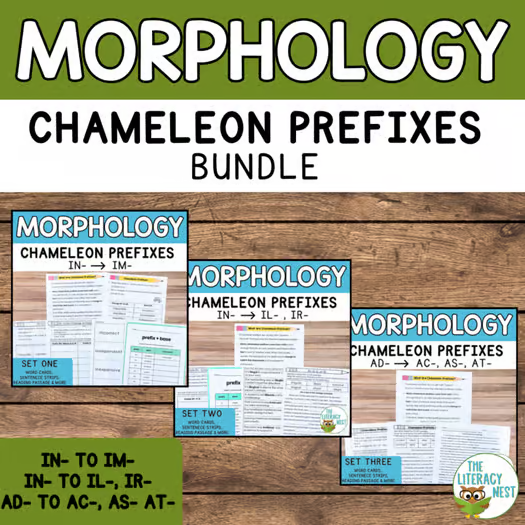
All of the assimilated prefix resources mentioned can be found in this time-saving assimilated prefixes bundle which includes a fourth bonus resource for prefix con to com.
Strengthen Prefix Instruction
If you want to streamline your word list creation, the Word List Builder desktop app from The Literacy Nest allows you to generate customized morphology-based lists. You can try the Word List Builder for free for 14 days when you choose a monthly or annual plan. Additionally, This video tutorial walks you through how it works.
Teachers can always use more ideas and demonstrations. This video is full of teaching tips you can implement today! It’s also important to implement practice in order to build automaticity. Thankfully, this free morphology games sampler from The Literacy Nest is a simple download. We know just how much students learn from a visual card drill. If you need to refresh your routine check out this article!
Student Success with Assimilated Prefixes
Assimilated prefixes are not random spelling quirks. They are predictable sound-based changes rooted in the history of the English language. When you teach them in a structured, systematic way, students begin to see order where they once saw confusion.
With a clear scope and sequence, a consistent lesson routine, and meaningful application in reading and writing, your students can move from guessing to understanding. And when that happens, longer academic words stop feeling intimidating and start feeling manageable.
Grab the Free Morphology Ladder Framework
If morphology instruction has ever felt a little scattered or hard to sequence, I created something to help.
My free Morphology Ladder Framework gives you a practical K-8 roadmap for how morphology can build over time. It is designed to help you understand what to teach, when to teach it, and how to think about the progression in a way that actually makes sense.
Inside, you’ll get:
- a practical overview of morphology development from Kindergarten through Grade 8
- a ladder framework to help you match instruction to student readiness
- guidance for thinking through what comes next
- a simple way to bring more clarity to your morphology instruction
If you want morphology to feel less random and more intentional, this framework is a great place to start.
And once you opt in, I’ll also walk you through more practical ideas for using the ladder, choosing the right starting point, and thinking about resources that support each stage.